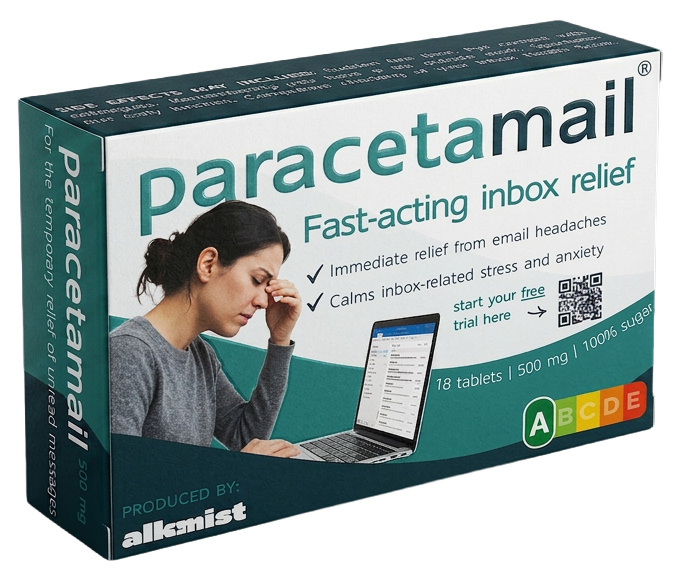
The productivity industry has spent close to two decades selling a single idea: get to inbox zero and you will feel calm. It is a great pitch. It is also a misreading of the concept that started the movement, and the psychology research that has accumulated since then explains exactly why an empty inbox does not deliver what it promises.
What Merlin Mann actually meant
In 2006, productivity writer Merlin Mann coined the phrase inbox zero on his blog 43 Folders. In 2007, he gave a Google Tech Talk that turned it into a movement. The productivity industry then spent fifteen years getting it wrong.
The zero, Mann said clearly, was not a reference to the number of messages in your inbox. It was, in his words, the amount of time an employee's brain is in his inbox. He restated this every few years. People kept missing it. Screenshots of empty inboxes became a status symbol. Articles on how to hit inbox zero in five steps stacked up. Mann himself eventually said publicly that he has a messy inbox and that is fine.
The point was never the count. The point was the absence of unresolved attention. An inbox full of decided-and-deferred messages does not bother you. An inbox of one undecided message can.
The Zeigarnik effect, explained
In 1927, a Soviet psychologist named Bluma Zeigarnik noticed something strange about waiters in Vienna. They could recall complex unpaid orders in detail. Once a bill was paid, they forgot it immediately. She ran controlled experiments and found that participants remembered interrupted tasks roughly twice as well as completed ones.
What she had identified, now called the Zeigarnik effect, is this: the brain treats unfinished tasks as active obligations. They stay partially loaded in working memory even when you are doing something else. Open loops, in cognitive science terms, occupy mental slots. Close them, and the slot reopens.
Later research by Masicampo and Baumeister at Florida State, published in 2011, showed that unfulfilled goals create intrusive thoughts that interfere with new tasks and degrade performance on unrelated work. You can be sitting in a board meeting, and the half-considered reply you owe a client at 4 PM is still consuming cognitive bandwidth.
Every unread email in your inbox is an open loop. Every email you have read but not decided on is a bigger one. Clearing the inbox to zero does not close the loop. It just hides where the loop lives.
What the email research actually shows
Gloria Mark, professor of informatics at UC Irvine, has spent twenty years studying how email affects knowledge workers. Her findings, replicated across multiple studies, are consistent.
In a 2012 controlled study with the U.S. Army, Mark's team gave one group of office workers normal email access and cut another group off entirely for five days. They monitored heart rate variability throughout. The group cut off from email had measurably more natural, variable heart rates. The group with normal email access stayed in a sustained high-alert state, the kind associated with chronic cortisol release.
A follow-up study by Mark and colleagues at Microsoft Research found that the longer a person spent on email in a given hour, the higher their measured stress. Email-checking frequency in their data averaged 74 to 77 times a day. The checking, more than the writing, was the stressor.
The practical translation: the act of opening the inbox is the cortisol trigger. Clearing it to zero does not undo the trigger. It just delays the next one.
Why this hits professional services harder
In most knowledge work, an email is a message. In professional services, an email is a decision.
A partner reading a client reply is doing two jobs at once. She is absorbing the information and making a series of micro-decisions on every line. Does this answer the request, or is something still missing? Does this need to go to the audit manager or stay with her? Does the deadline shift? Does the engagement letter need an addendum? Is this a billable conversation or scope creep? Each of those is an open loop until she decides.
Multiply that by 117 emails a day, the average for a knowledge worker according to the Microsoft Work Trend Index 2025. Most of those decisions stay unresolved at the moment of reading. For a senior in audit, tax, M&A, or insurance, the inbox functions as a queue of unmade decisions in chronological order.
This is why an empty inbox at 9 PM on a Sunday does not deliver peace. The messages are gone. The decisions have just moved into your head, where they will surface at 3 AM on Monday wondering whether you committed the firm to something you did not mean to.
The limits of a better email method
Fifteen years of inbox zero advice has tried to solve this with more discipline. Process every email once. Delete, defer, delegate, do. Batch your replies. Turn off notifications. Set an out-of-office on Saturdays.
All of it helps a little. None of it solves the underlying problem, which is that the inbox was never built to be a decision system. It was built to be a chronological list of unstructured text. It cannot tell you which open loops are urgent. It cannot remember a decision once you have made it. It cannot show you, across forty active client engagements, which document requests are still outstanding and which are closed.
So the senior carries that map in her head. And the brain, doing what Zeigarnik described in 1927, refuses to let her forget.
What changes when decisions live somewhere else
This is the gap Alkmist closes. We built a coordination layer for professional services firms where every document request, approval, clarification, and sign-off lives as a structured task, not an email. Each task has an owner, a deadline, and a state. When a request is closed, it is closed. The loop shuts, and the brain releases it.
Last month we launched the Inbox Agent. It reads incoming client emails, recognises which ones tie to active requests in your engagement, extracts the document or response, files it against the right task, and updates the status. The email never has to become a decision in your head. The decision was already made when the request was structured.
For a senior, this changes the psychology of the inbox. The inbox stops being a list of open loops. It becomes a notification surface for a system that holds the decisions. The cortisol trigger of opening Outlook on a Sunday night fades, because the inbox no longer contains anything unresolved.
Inbox zero, in the way Merlin Mann actually meant it, becomes possible. Not because the inbox is empty, but because the brain is.
See how the Inbox Agent works →
Sources: Merlin Mann, 43 Folders blog and 2007 Google Tech Talk on Inbox Zero; Bluma Zeigarnik (1927) on memory of interrupted tasks; Masicampo & Baumeister (2011) on unfulfilled goals and cognitive load; Gloria Mark et al., "A Pace Not Dictated by Electrons" (UC Irvine and U.S. Army, 2012); Mark, Iqbal, Czerwinski & Johns (Microsoft Research, 2016) on email duration and stress; Microsoft Work Trend Index 2025; cloudHQ Workplace Email Statistics 2025.