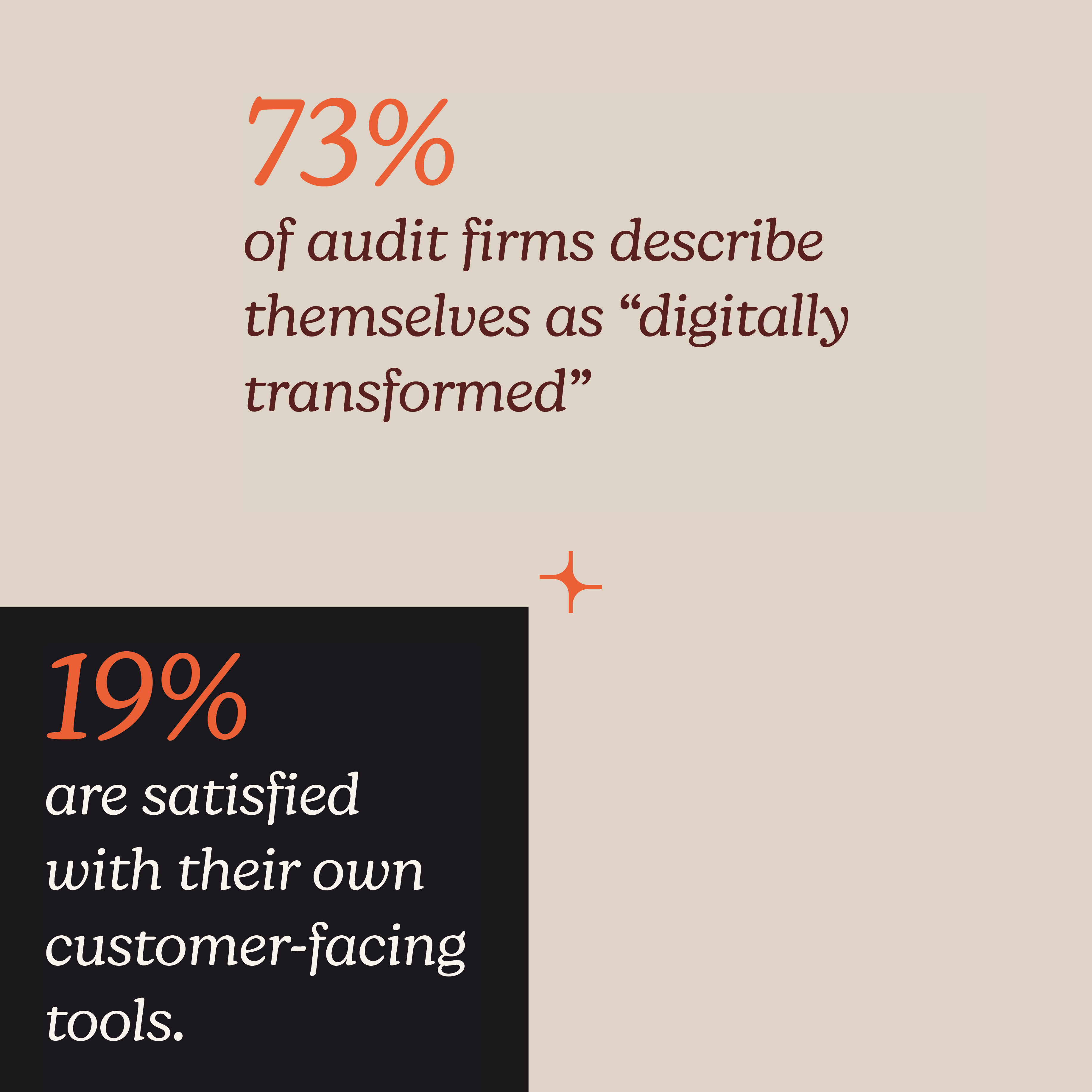
73% of audit firms call themselves "digitally transformed." Only 19% are satisfied with their own client-facing tools. Those numbers come from State of the Audit 2025, the research report that Ghent University published in partnership with Alkmist, based on data from 150 auditors and more than 100 clients across Europe.
It's one of the most striking findings in the study. And it touches a pattern that reaches far beyond audit. Accountants, lawyers, M&A advisors, insurance brokers, architects: wherever professionals structurally collaborate with external parties around documents, deadlines, and approvals, the same gap shows up. Money goes into tools. But the client doesn't notice. (And when they do, the experience is rarely positive…)
This article, the second in a series based on the State of the Audit 2025 research, zooms in on that gap. We deliberately look beyond the technology, focusing mainly on the behavior behind it.
Knowing ≠ Doing
Good doctor, bad patient. That's what's going on. Firms that advise their clients daily on process optimization, compliance, and digitization rely internally on tools and workflows they would reject at those same clients. Files scattered across email and shared drives. Reporting built on spreadsheets. Critical knowledge stored in the heads of a handful of experienced staff.
This isn't a matter of ignorance. Most partners can point out the inefficiencies without thinking twice. They know. They just don't act on it.
Your Telecom plan on the server
One of the most robust findings in behavioral science is the default effect. It's what happens when you don't make an active choice. Think about the ringtone on your iPhone. It's probably still set to the classic "Marimba" sound. Or the language on your laptop, set to whatever came in the box. Someone else made that choice for you, and you never changed it. You didn't run a careful cost-benefit analysis. It was already there, and that was enough.
Behavioral economists Samuelson and Zeckhauser gave it a name in 1988: status quo bias. Where the default effect is about the power of the pre-set option (what happens if you do nothing?), status quo bias adds an emotional layer. The familiar starts to feel like it belongs to you. You grow attached to what you know, even if you never consciously chose it in the first place.
In practice, these two reinforce each other. The default effect creates the situation. Status quo bias keeps you in it.
With retirement savings, employees overwhelmingly choose the default fund, even when better options are available. The fund is the default, and over time it becomes the status quo. With organ donation, the number of donors jumps dramatically when the standard choice changes from "no, unless you opt in" to "yes, unless you opt out." Nobody changed their mind about organ donation. The default changed. And that was enough.
What does telecom have to do with this? A lot.
A recent BIPT study on the Belgian telecom market shows both mechanisms in dollars and cents. Consumers stick with their current plan, even when they could save hundreds of dollars a year by switching. The plan auto-renews (default), and by now it feels like something familiar (status quo). Satisfaction has little to do with it. It's inertia, reinforced by attachment. The path of least resistance is doing nothing.
In professional services, that inertia sounds different, but the logic is identical.
"We've always had that folder structure on the server." "Clients are used to email, they're not going to use a portal." "Our current CRM isn't perfect, but everyone knows how it works."
Over time, the existing way of working becomes the implicit standard. Maybe slow, fragmented, or error-prone. But it doesn't require a new decision, no learning curve, no disruption. Change, on the other hand, costs attention and energy. It means revisiting processes, training people, accepting a period of uncertainty, colleagues who complain. Our brains are built to avoid that kind of effort. Even when the business case for improvement is clear.
Why risk always feels bigger than reward
Once the status quo has settled in, a second mechanism starts to play. Professionals build narratives that justify staying put. "What if the migration takes more work than expected?" "What if we lose data?" "What if the new way of working doesn't suit everyone?"
Those explanations sound rational. They rarely are. Most of the time they reflect loss aversion, described by Kahneman and Tversky in their Nobel Prize-winning work on prospect theory. The core idea is simple: a loss weighs roughly twice as heavy as an equivalent gain. Losing a hundred dollars hurts more than winning a hundred dollars feels good.
In the telecom market, you can see it in the numbers. Consumers only consider switching when the annual savings feel large enough, while the accumulated gain over five years can be substantial. In professional services, the same pattern plays out, but in time rather than money. A new solution might save a few hours of administrative work per person per week. At first glance, modest. But those hours add up over a year and across an entire team. They become room for more client work, faster turnaround times, or simply less evening and weekend work.
The potential "loss" of comfort, control, or familiarity during a transition weighs twice as heavy as that structural gain. So we postpone.
24 jars of jam and no bread in sight
There's another barrier. And it has nothing to do with willpower or strategy.
Psychologist Sheena Iyengar set up two tasting tables in a supermarket: one with 6 types of jam, the other with 24. The large table attracted more curious visitors. But when it came to actually buying, the small table performed ten times better. 30% of tasters bought a jar, compared to just 3% at the large table. When the number of choices exceeds a handful, doubt creeps in, the fear of picking the "wrong" option grows, and we end up choosing nothing.
Barry Schwartz explored this further in The Paradox of Choice: more options don't lead to better decisions. They lead to paralysis.
Professional service providers face their own version of those 24 jars every time they look at their technology stack. Project management, client portals, document management, workflow automation, CRM, AI assistants. The market for professional service technology has exploded in recent years. Every option raises questions about integration, compatibility, configuration, and change management.
Decision-makers experience fatigue and put it off. "We'll look at it after the busy season." "We need to map out all our processes first." And so the existing system starts to feel surprisingly attractive. However imperfect it is, at least everyone knows how to work around the limitations. "Good enough" quietly becomes the default strategy.
The numbers behind the feeling
The State of the Audit 2025 data makes this pattern measurable.
42% of firms still work primarily with email and Excel. 35% use a mix of generic platforms: SharePoint, Dropbox, WeTransfer. Only 23% have an integrated platform.
72% described their client-facing tooling as slow and too manual. 62% work with three or more separate systems to manage document requests. Not a single firm had a centralized client knowledge base. (Not even the Big 4.) 67% rely on their own memory to retrieve relevant context. 43% acknowledged that critical knowledge was lost when a team member was absent.
And the client? 64% described the experience as fragmented, slow, or hard to follow. 61% had to resend documents more than once. 70% had no visibility into progress, responsibilities, or timing. 54% said collaboration has gotten harder since 2020.
From knowing to doing
Those numbers surprise no one who works in the sector. That's precisely the point.
Nugawela and Sedera (2022) mapped three psychological mechanisms in a systematic literature review that work together to block change: we underestimate the costs of the current situation, we overestimate the costs of the transition, and we are emotionally attached to the tools we know. Oschinsky et al. (2021) confirmed that pattern among professionals in the public sector: even when employees recognize the benefits of new technology, resistance stays high.
Real change happens when organizations recognize those forces and deliberately design around them. By making the new way of working the default. By shrinking the first step down to something manageable. By making the real cost of the current situation visible in hours, dollars, and lost clients.
AI doesn't build on quicksand
Meanwhile, AI sits prominently on the innovation roadmap. Three out of four auditors expect their firm to invest heavily in AI tooling over the next three years. But fewer than half trust that the existing infrastructure can handle that step.
Research from MIT's NANDA Initiative (2025), based on 150 interviews with executives and analysis of 300 public AI implementations, confirms that concern. 95% of generative AI pilots fail to deliver measurable returns. The technology (usually) isn't the problem. The processes underneath were simply never cleaned up.
So the real question isn't which AI tool you buy. The question is which "telecom plans" inside your firm are still active, simply because they became the default and were never questioned.
Anyone willing to answer that question honestly has taken the first real step away from the default.
Four exercises you can do this week
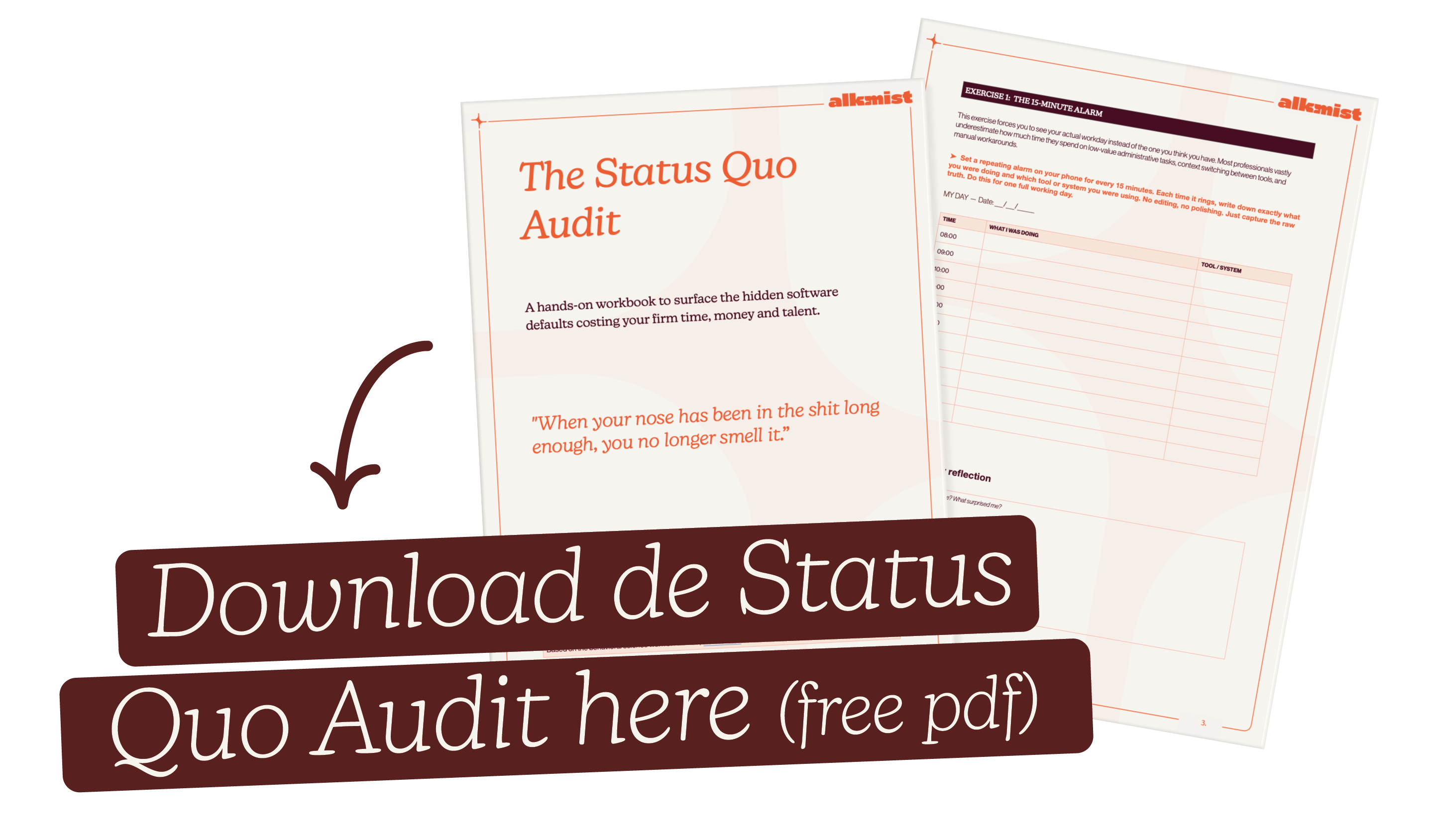
These exercises come from the Status Quo Audit, a free workbook we created based on this article. Each of the four exercises below takes less than fifteen minutes.
1. Set an alarm every fifteen minutes. For an entire workday. Each time it rings, jot down in two words what you're doing. At the end of the day, count: how many moments went to follow-up emails, status questions, requesting documents? And how many went to actual substantive work? Most professionals are startled when they see it in black and white.
2. Map the journey of your documents. Pick one client file and trace the path of a document, from the moment the client sends it to when it lands in the right system. How many times is it renamed, moved, copied? At most firms in our research: four times or more. Every intermediate step is a chance for something to go wrong.
3. Make a list of all your tools. Everything you pay for or that your team uses daily. For each tool, ask three questions: is it actually still used? Does it solve a specific problem? Can a new team member get started with it within a day? Every "no" is a tool running on habit, not on value.
4. Ask your clients. One question, to five clients: "Can you see where your file stands at any moment, without emailing or calling us?" For 70% of clients in our research, the answer was no. That single question tells you more than any internal audit.
Ready to Test It?
We developed a free, printable workbook based on the behavioral science in this article. Six exercises, designed to work through with your leadership team in 90 minutes. It includes the 15-minute alarm that reveals what your day actually looks like, a blind-spot checklist of the 20 most common friction points in professional services, and a cost calculator that puts a dollar amount on your status quo.