Ask a client what they remember about your professional collaboration, and rarely does the answer start with the end result. What sticks is the journey: were requests clear? How responsive was the professional? Was there any visibility into progress? Did everything need to be chased, or did the work sometimes seem to simply grind to a halt? That experience matters. More than most firms realise. Because a client does not judge a collaboration by the financial statements, the audit report or the legal advice delivered, but by the hundreds of small moments that came before it.

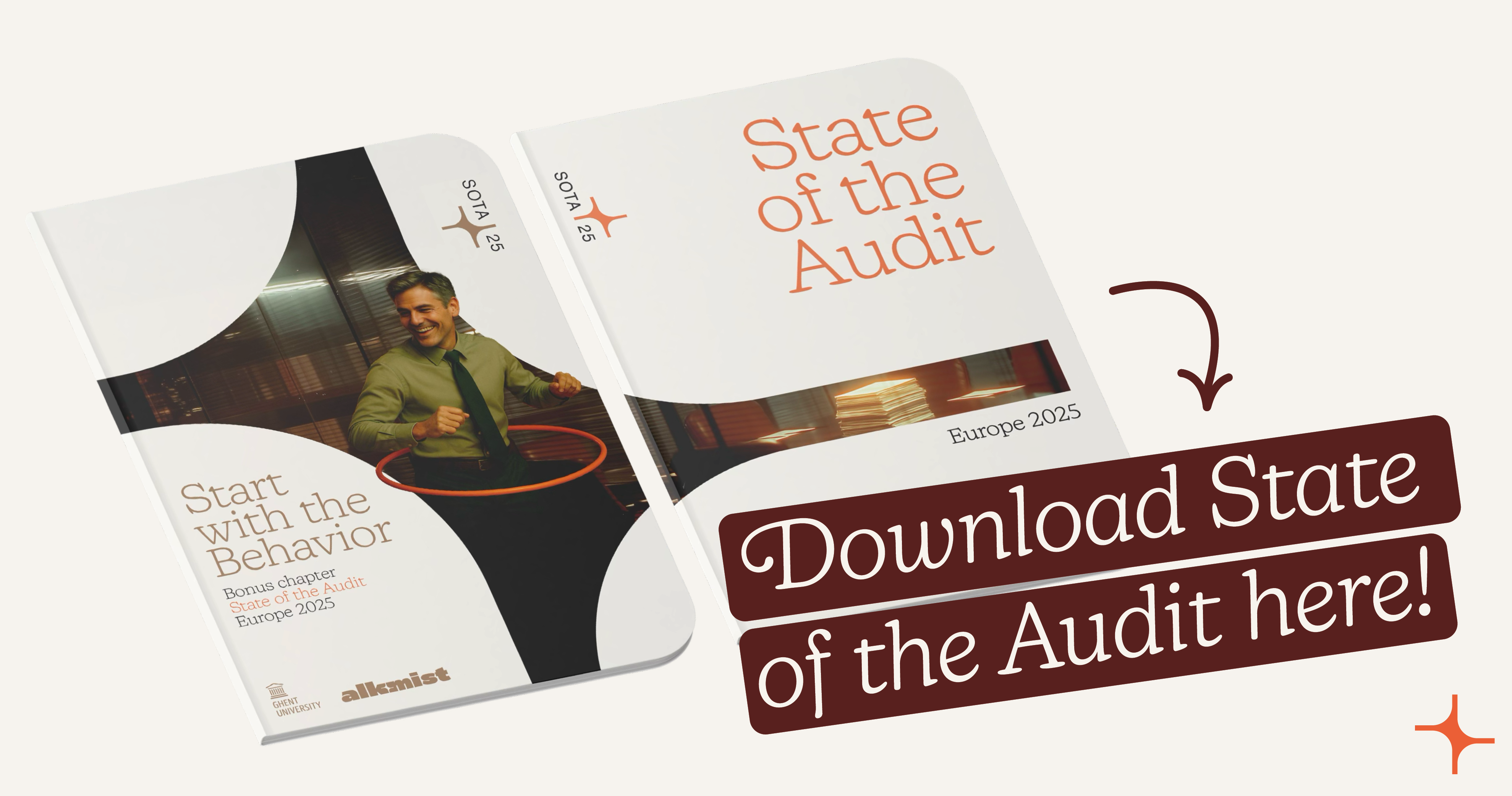
That insight forms the foundation of State of the Audit 2025, a research initiative conducted by Ghent University in partnership with Alkmist, drawing on the experiences of 150 professional service providers active in audit and more than 100 clients across Europe. The findings confirm a pattern that extends well beyond audit: work gets delivered, but coordination is fragile. Tools are digital, but poorly integrated. Progress is made, but rarely visible. And context is repeatedly lost between people, systems and subsequent engagements.
This is the first article in a series that will zoom in on one theme from the research at a time. Each piece translates the findings into practical insights for professionals in audit, tax, accounting, legal and related services.
The hidden cost of coordination
One insight stands out immediately: coordination alone accounts for between 15% and 35% of professional time. Status updates. Follow-up emails. Clarifications about what was requested, what was submitted, what was reviewed and what is still outstanding. The work between the "real work," steadily pulling time away from substantive value creation.
In practice, it sounds like this:
- "Didn't I already send that?
- Or was that for a different document?"
- "I forwarded that, but I can't remember to whom."
- "Is this file closed, or is something still pending?"
- "Are we waiting on them, or are they waiting on us?"

In the data, these moments accumulate. The average audit generates more than 2,000 emails; most are not about substantive insights but about progress, missing attachments or repeated requests. Even teams working with portals or shared drives still lean heavily on email to make up for what their process lacks.
When each message takes only a few minutes to read, interpret, respond to or forward, the cumulative impact quickly runs into hundreds of hours of low-value effort per engagement.
The problem? Most professionals no longer feel it. Walk behind the rubbish truck long enough and you stop smelling the waste. Coordination load has become so embedded in daily work that it has turned invisible. But why should professionals have to piece together every status update from fragmented email threads, when a system could display that information clearly?
Cognitive switching costs: The mental cost of coordinating by Email
Every time a professional switches between substantive work and coordination, there is a price to pay. In psychology, this is called cognitive switching costs: the mental toll of constantly pulling your attention away from one task and redirecting it to another.
Research consistently shows that after each interruption, it takes an average of 15 to 25 minutes to regain full concentration on demanding work. In an environment where follow-up emails, status requests and clarifications trickle in throughout the day, deep substantive work becomes a luxury. Professionals are pushed into ‘reactive mode’ : putting out fires, answering questions, following up on things. Working proactively on insights or advice? There simply is not enough time for it.
When dozens of follow-up emails, status requests and clarifications seep through the day, deep substantive work does not just become harder. It becomes structurally impossible.
By the end of the day, everyone has been busy. But busy doing what?
Starting from zero, year after year
On the client side, the signals are equally clear.
- 68% of clients report having to explain the same basic information about their organisation year after year.
- 70% have no clear view of the progress, responsibilities or timing of the audit.
- 61% were asked to resubmit documents they had already provided, not because something was missing, but because the firm could not locate them.

More than thirty years of psychological research points to the same pattern: people remember moments, not averages. Yet most professional service providers implicitly assume they do. The reasoning feels sound: as long as the project manager is accessible and personable, the work is delivered correctly and the client is not complaining, everything must be fine.Right?
It is a rational tally of satisfaction. But that is not how the human mind works. What clients actually remember comes down to three things: the beginning (the onboarding), the end (the closing moment), and the peaks in between. In psychology, this is known as the peak-end rule.For professional service providers, that is an uncomfortable truth. Building a strong impression takes considerable effort. A single negative peak can undo all of it. A chaotic onboarding, a week of radio silence at a critical moment, a reminder email with just a hint too much frustration, a deliverable dropped in without context or explanation. These are the moments that stick, and they colour everything else.

That mechanism is nothing new. Neither is the solution. In June 2010, Uber disrupted the saturated San Francisco taxi market using exactly these insights into how people think and behave. There was no shortage of taxis.
The onboarding? A single tap. The ending? An automatic payment, a quick rating, done. Every touchpoint was designed to eliminate friction. And the peaks in between? They played directly into our natural aversion to uncertainty. A live map showing exactly where your driver is in real time. Knowing your taxi is eight minutes away is far less unsettling than not knowing whether it will be four minutes or forty. Uber did not solve a taxi problem. They solved a psychological one.
Professional services operate in far more complex environments, yet often offer less visibility into progress. Does your client know at every moment where they stand in an engagement? Can they see what is still outstanding, what has been received and what has been completed, without having to send a follow-up email? Professionals who start from a deep understanding of how people function, and only then look at technology, will make the greatest strides in both client experience and efficiency.
Digital does not mean integrated
Many firms today position digital transformation and AI as the solution. The State of the Audit 2025 research, however, reveals a clear gap. While 73% of professionals believe their organisation is digitally transformed, only 19% are satisfied with the tools being used on the client-facing side.
Technology has been bolted on as an extra layer, but integration has not followed. Generic platforms are repurposed for specific needs, while workflows spread across email, spreadsheets, portals and shared drives that barely communicate with one another. Information circulates continuously but rarely builds on what was previously captured. This is reinforced further by the finding that just 22% of professionals report that client feedback actually led to changes in how the engagement was run.
That makes the current AI rush all the more striking. At conferences, in boardrooms and on LinkedIn, AI strategies and innovation roadmaps are everywhere. The Big Four beat their chests about billions in AI investment and the thousands of AI agents they have deployed. That pressure filters down. Smaller and mid-sized firms in audit, tax, accounting and legal feel compelled to move, afraid of missing the boat. Yet on their own floors, those same organisations still send dozens of manual follow-up emails every day just to find out where their files stand. Recent MIT research confirms the trend: 95% of AI initiatives at large organisations fail. Not because the technology falls short, but because the underlying processes were never sorted out. If even the Big Four run into that wall, what does it mean for everyone else?
Meanwhile, the low-hanging fruit goes unpicked. The gains are not in the next technological layer. They lie in eliminating the friction that has been there for years: clear requests, visible progress, context that is preserved. The fundamentals of how people function, applied to how firms do professional work. No AI required.
The low-hanging fruit
The findings from State of the Audit 2025 hold up a mirror to professional service providers. They point to a sector that has grown accustomed to friction. A sector under pressure, wrestling with growing complexity, AI FOMO and processes that no longer match the reality of daily work.
The solution does not start with technology. It starts with recognising that client experience is not a byproduct of good work. It is the result of deliberate choices about how that work is organised.
Design the peaks. The peak-end rule teaches professionals that clients judge a collaboration on a handful of key moments: the onboarding, the delivery and the moments of friction in between. Firms that consciously shape those moments, rather than leaving them to chance, build stronger client relationships in a lasting and structural way.
Make progress visible. Uber understood this in 2010: uncertainty erodes trust. A client who can see where their file stands, what has been received and what the next step is asks fewer questions, feels more in control and perceives greater professionalism. Not because the work is better, but because it is visible.
Protect your experts' focus. Every follow-up email, every status request, every interruption triggers a cognitive context switch. Professionals who are constantly interrupted by coordination work end up operating reactively rather than proactively. Systems that manage progress themselves, rather than placing that responsibility on people, give experts their focus back.
Preserve context. A client who has to explain the same basic information every year experiences precisely the kind of negative peak the peak-end rule describes. Knowledge continuity across engagements and team changes is not a luxury. It is the bare minimum for a collaboration that feels genuinely professional.
None of these changes require significant investment. The AI train is not slowing down, and boarding it is not getting any easier. Those who pick the low-hanging fruit today are building the foundation to keep pace tomorrow. Those who leave it hanging will eventually board a train they cannot steer.
State of the Audit 2025
This article is the first in a series appearing over the coming months. Each piece dives deeper into one specific theme from the research, with concrete takeaways for professionals in audit, tax, accounting, legal and other knowledge-intensive services. For those who cannot wait: the full State of the Audit 2025 report brings together all the data, analyses and insights, freely available and immediately applicable to your own practice.