By Mathias Celis, PhD
What the numbers show
The Ghent University researchers surveyed 1,333 Belgian employees. 31% are in the danger zone for burnout, and almost half of that group runs a very high risk.
More interesting than the headline number is what employees point to as the biggest obstacles to their wellbeing. Cognitively demanding work comes first (65%), followed by bureaucracy (58%) and a heavy administrative load (53%). Almost half also say they have to carry out tasks that are unnecessary, or that could be simpler if the work were better organised.
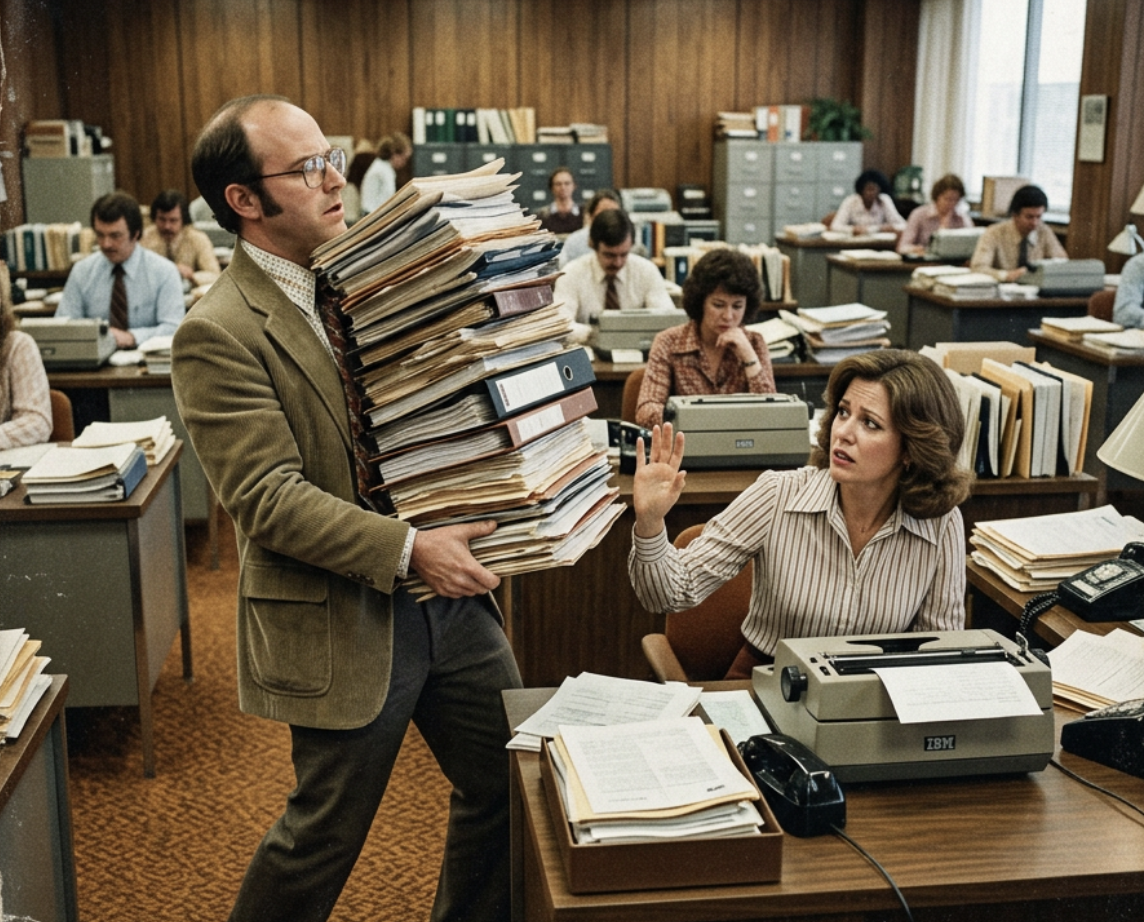
That cognitive load is unevenly distributed. It mainly hits knowledge workers, so people like you and me. The lawyer, the in-house counsel, the notary and the accountant, who make a living from what they know and the judgement they build on it. Among blue-collar workers, 47% find their own work cognitively demanding. Among white-collar workers that rises to 70%, and among the highly educated to 74%.
For the legal world this will hardly come as a surprise. In 2019 the Flemish Bar Council surveyed more than 1,500 lawyers: almost nine in ten experienced stress at work. In the 2020 Lawyers' Barometer, 84% (!) feared a burnout, and barely one in four said they never worked at the weekend or during holidays. A deadline does not wait until Monday, and neither does a client.
Why breathing exercises are not enough
Ghent University also asked employees which measures they believe in. Meditation and resilience training end up right at the bottom: only 24% are convinced they can improve their wellbeing. Adjusting tasks and working hours comes out on top, at 60%.
The researchers rightly note that there is scientific evidence for meditation. It just mainly helps you tolerate the work. The work itself stays what it is. Employees clearly sense that.
Nearly every wellbeing study maps the symptoms neatly and sooner or later lands on the same umbrella: too much administration. Everyone nods. But what do you actually do on a Tuesday morning when you are "doing admin"? We measure how heavy that overhead weighs, and rarely ask where it comes from.
The blind spot: your inbox
Email is older than the internet itself. The first message between two computers was sent in 1971, meant to let researchers send each other short notes. Put an email program from back then next to your inbox today and, apart from a few stylistic differences, you see fundamentally the same thing: a long chronological list of unstructured messages.
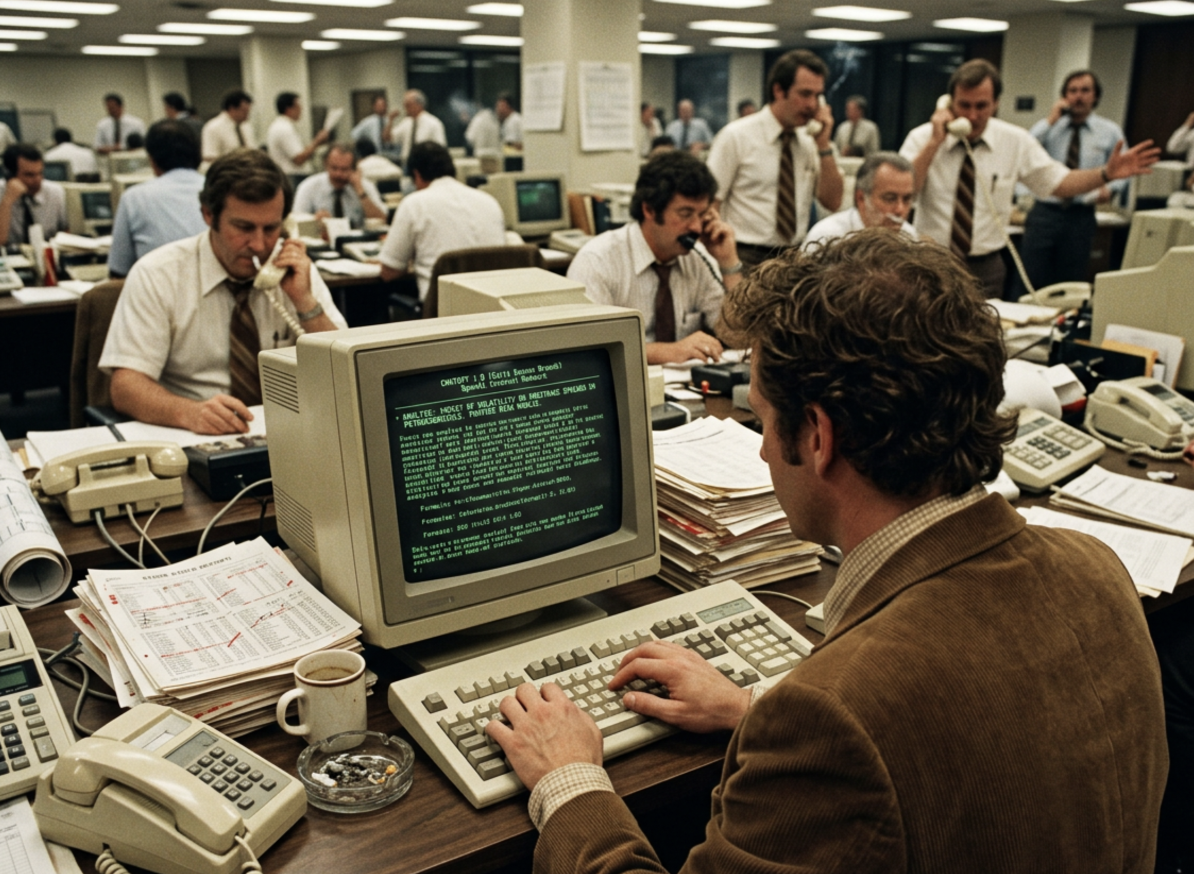
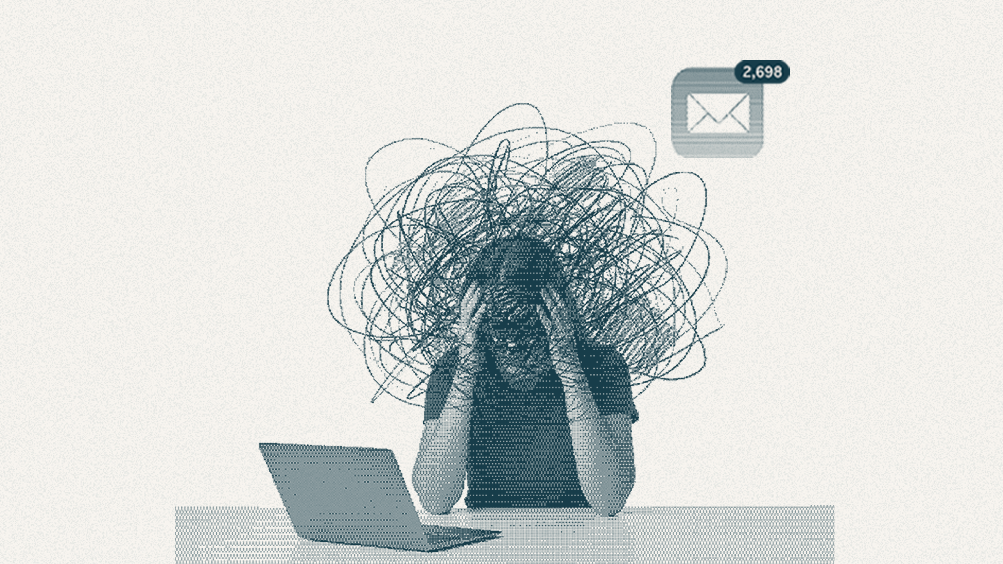
Today every professional uses that list to coordinate work. Despite its popularity, it was never built for that. And it only gets longer. In 2015, Radicati estimated that a business user received 88 emails a day. By 2025, Microsoft counted 117, or one every four minutes. Add chat messages and meeting requests, and the most heavily loaded users reach 275 interruptions a day.
You probably recognise it. The client who sends a "quick" email at 10.17 pm. The thread where a deadline was agreed somewhere in message eleven. The five emails back and forth to find a single meeting slot.
Since we all started carrying a smartphone and were collectively trained to be reachable at all times, the consequences have become visible too. Research shows that office workers now check their mailbox an average of 77 times a day. With every email your brain has to load new context, only to switch to the next one straight after, without ever really ticking anything off. That comes at a mental price. For many professionals, this may well be the source of the cognitive and administrative overload in the Ghent University figures I opened this article with.
The problem is not new. For 30 years, research has shown that people use their inbox as a to-do list. A to-do list that anyone with your address can add to, whenever they like. Your work runs per client, per file, per deadline, and your inbox sorts by time of arrival. Every question about where things stand becomes digging.
"But I file everything neatly in folders per client," I hear you think. Researchers at IBM followed 345 email users. Those who dragged everything into folders did not find their emails back any more often than those with no structure at all. A folder stores things. It does not tell you who still has to reply or which deadline is running.
Thirty years on, that inbox is still a blind spot. We have been walking behind the garbage truck called the inbox for so long that we no longer smell it. And now that clients and colleagues are using AI to generate more output, faster than ever before, it is not going to get better. That bodes ill for the administrative burden, and for the mental health of you and your staff. At the same time, the inbox is the low-hanging fruit: one place, where you already sit every day. Tackle that first and you treat the disease instead of the symptom.
The solution for your inbox problem
How do we get that coordination work off the shoulders of knowledge workers? By showing the right information at the right moment. Using insights from behavioural psychology and the recent possibilities of AI, I built a solution for this professional blind spot: Pidgy.
Pidgy is your AI secretariat. It works with your existing Outlook, Gmail or IMAP, so you do not have to move anything or radically change the way you work. Pidgy reads your emails and meeting notes, pulls out the tasks and puts them in one action plan. The digging disappears, because you can see at a glance who you are still waiting on and who is waiting on you.
For every reply, a draft is ready in your own writing style. Pidgy also helps you coordinate meetings, so that no five emails need to be ping-ponged for that either.
You work with confidential files and professional secrecy. Where your emails end up is therefore the first question, not the last. Pidgy is ISO 27001 certified and built for legal professionals. Your data stays in the EU, is encrypted and is never used to train an AI model.
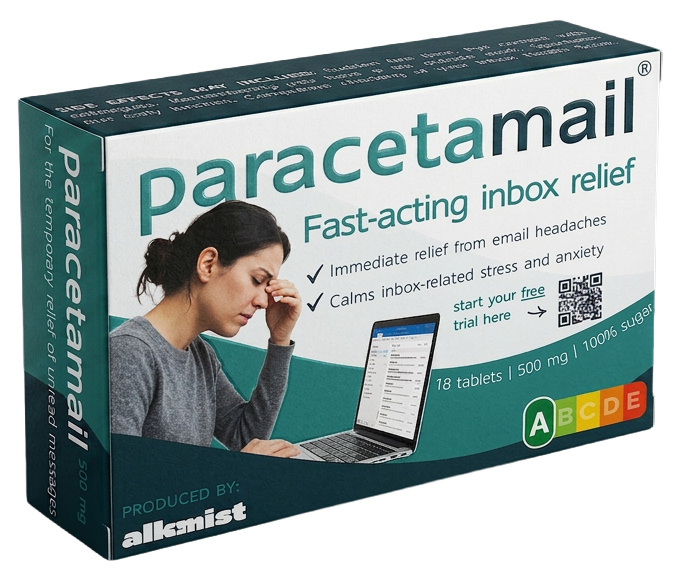
The worst that can happen is that you stop after two weeks and know exactly how much coordination work was sitting in your inbox. Start your free trial here.
Mathias Celis, PhD
References
- Dalle, A., Annemans, L., Baert, S., Clays, E., Derous, E., Dierickx, L., Kozusznik, G., Neyt, B., Schroth, L., Van Ootegem, L., Van Simaeys, H., & Verhofstadt, E. (2026). Mentaal welzijn op het werk in België: Nieuwe cijfers en duiding vanuit onderzoek (UGent@Work Policy Brief 28). Ghent University. https://www.ugentatwork.be/nl/policy-briefs/mentaal-welzijn-op-het-werk-belgie
- Dillon, E. W., Jaffe, S., Immorlica, N., & Stanton, C. T. (2025). Shifting work patterns with generative AI (arXiv:2504.11436). arXiv. https://arxiv.org/abs/2504.11436
- Henri. (2020, 20 February). 1 op 3 advocaten ervaart problematisch veel stress [results of the Flemish Bar Council wellbeing survey]. https://henribaliemagazine.be/1-op-3-advocaten-ervaart-problematisch-veel-stress
- Leroy, S. (2009). Why is it so hard to do my work? The challenge of attention residue when switching between work tasks. Organizational Behavior and Human Decision Processes, 109(2), 168–181. https://doi.org/10.1016/j.obhdp.2009.04.002
- Mark, G., Iqbal, S. T., Czerwinski, M., Johns, P., Sano, A., & Lutchyn, Y. (2016). Email duration, batching and self-interruption: Patterns of email use on productivity and stress. In Proceedings of the 2016 CHI Conference on Human Factors in Computing Systems (pp. 1717–1728). ACM. https://doi.org/10.1145/2858036.2858262
- Microsoft. (2025, 17 June). Breaking down the infinite workday (Work Trend Index Special Report). https://www.microsoft.com/en-us/worklab/work-trend-index/breaking-down-infinite-workday
- Orde van Vlaamse Balies. (2021). Advocatenbarometer 2020 [summary of results]. https://www.ordevanvlaamsebalies.be/nl/over-ovb/advocatenbarometer
- Whittaker, S., Matthews, T., Cerruti, J., Badenes, H., & Tang, J. (2011). Am I wasting my time organizing email? A study of email refinding. In Proceedings of the SIGCHI Conference on Human Factors in Computing Systems (pp. 3449–3458). ACM. https://doi.org/10.1145/1978942.1979457
- Whittaker, S., & Sidner, C. (1996). Email overload: Exploring personal information management of email. In Proceedings of the SIGCHI Conference on Human Factors in Computing Systems (pp. 276–283). ACM. https://doi.org/10.1145/238386.238530