The coordination tax nobody measures
SPI Research tracks operational health across professional services every year. Their 2025 Professional Services Maturity Benchmark Report found that EBITDA for professional services firms shrank to 9.8% in 2024, down from 16.1% in 2022. That's a steep drop. And the report flagged two root causes: declining utilization rates and operational inefficiency.
Not a lack of talent. Not a lack of clients. Inefficiency.
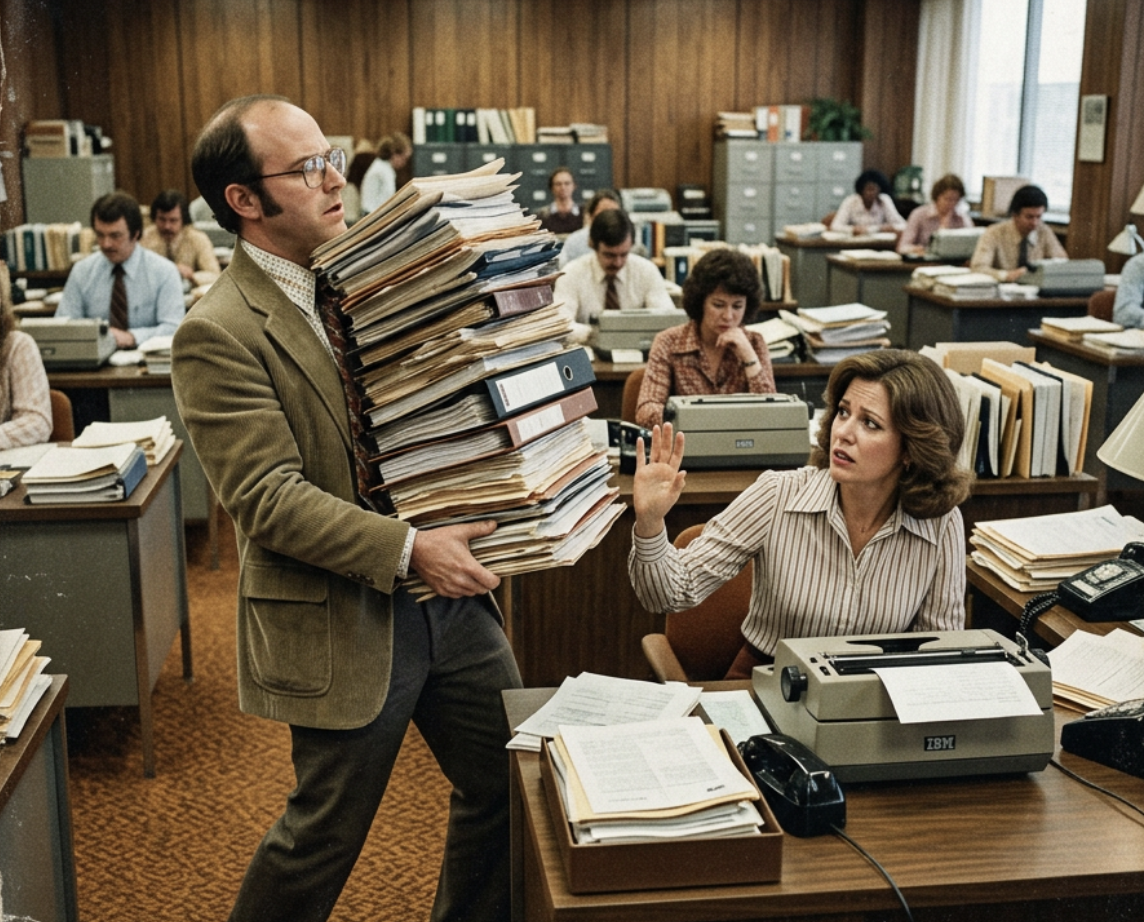
Where does that inefficiency live? In the coordination layer. The emails sent to chase a missing balance sheet. The follow-up to the follow-up. The Excel request list that three people edited offline, creating three different versions. The status meeting that exists only because nobody can see progress without asking.
McKinsey's workplace productivity research found that employees waste an average of 1.8 hours per day searching for information. Nearly a quarter of the workday, gone. In professional services, where every hour has a price tag, that waste compounds fast.
A separate 2025 survey of over 6,000 knowledge workers found that 79% blamed constant emails and messages for workplace overwhelm. And Accounting Today reported that more than 30% of engagements across all firm sizes (Big Four, Top 100, mid-sized, and small) fail to meet basic benchmarks for being on time or on budget.
Thirty percent. Across the board.
The real bottleneck is between firms and clients
Most conversations about efficiency focus on internal tools. Better project management. Smarter task routing. Faster review cycles. Those matter. But they miss the biggest friction point: the space between your firm and your client.
That's where documents get lost in inboxes. Where requests land without enough context. Where clients respond to the wrong thread, attach the wrong file, or simply don't respond at all because they couldn't figure out what was being asked.
The Financial Cents report confirmed this. Getting documents from clients surpassed manual administrative tasks as the number one workflow challenge in 2025, overtaking the issue that held the top spot in previous years.
Think about what that means. Firms have been buying tools, hiring staff, and building processes for years. And still, the single biggest bottleneck is getting information from the people they serve.
Wolters Kluwer's 2025 Future Ready Accountant report, which surveyed over 2,700 professionals across 14 countries, backs this up from a different angle. Firms ranked improving client service and operational efficiency as their top goals for 2026. And the report found that high-growth firms were 53% more likely to have integrated systems connecting their client-facing workflows.
The gap between high-growth firms and everyone else isn't about who has better accountants. It's about who has better coordination infrastructure.
AI is accelerating. The foundation is missing.
AI adoption in professional services is moving fast. Thomson Reuters' 2026 AI in Professional Services report surveyed 1,500+ professionals and found that 40% of organisations now use generative AI, up from 22% the year before. Over 80% of current users engage with it at least weekly.
McKinsey's 2024 Global Survey on AI confirmed that professional services saw the biggest jump in AI adoption of any industry, rising from roughly 33% to 65% of organisations in a single year.
But here's the catch. Kantata's 2025 State of the Professional Services Industry report found that 89% of services leaders who use AI outputs still spend significant time verifying those results. And Runn's State of Resource Management 2026 report found that only 9% of respondents fully trusted their data.
Nine percent.
AI needs structured data to be useful. It needs clear inputs, defined ownership, and visible progress. If your client collaboration still runs through email, there is nothing structured for AI to work with. You're asking a smart system to make sense of a mess.
The firms that will benefit most from AI are the ones building the structured collaboration layer first. Not the ones buying the fanciest copilot.
What structured collaboration actually looks like
Professional services work follows predictable patterns. An engagement starts. Documents are requested. Clients provide information. Teams review, clarify, and follow up. Sign-offs happen. The engagement closes.
Every step in that chain involves coordination between your firm and your client. And for most firms, that coordination still happens through email, spreadsheets, and shared drives with inconsistent naming conventions.
A structured collaboration environment changes this. Document requests become clear action items with ownership, deadlines, and acceptance criteria. Clients see exactly what's needed and what's still pending. Professionals see who owes what by when. Every interaction is traceable and auditable.
This isn't about adding another tool on top of email. It's about replacing email as the coordination layer for structured client work.
When the system itself makes the next step obvious (through clear defaults, visible progress, and low-friction paths) completion rates go up. Follow-ups go down. And the engagement team gets to spend time on the work that actually requires their expertise, instead of chasing documents.
The burnout angle nobody connects
The University of Georgia and FloQast published a study surveying over 1,000 U.S. finance and accounting professionals. The finding: 99% of respondents reported experiencing fatigue, inefficiency, or detachment from their jobs.
Ninety-nine percent.
The study identified administrative burden and manual processes as leading contributors. That aligns with what every partner already knows but rarely measures: the invisible work of coordination eats capacity. It's not on the timesheet. It doesn't show up in utilization reports. But it's the reason senior staff answer emails at 10 PM and still feel behind.
Reducing coordination overhead doesn't just improve margins. It gives people their time back. And in an industry where talent shortages are the norm, keeping your people engaged matters as much as keeping your clients happy.
The window is narrowing
CPA Practice Advisor's year-end technology review for 2026 made a clear observation: the firms pulling ahead are the ones consolidating scattered point solutions into core work platforms. Platforms that capture the data AI needs in one place and then automate the low-value work within that structure.
The Thomson Reuters report projects that 95% of professionals expect generative AI to become central to their workflow within five years. The question for most firms isn't whether to adopt AI. It's whether their infrastructure can support it.
And infrastructure starts with how you collaborate with your clients.
Firms that close this gap now will compound that advantage. Better data leads to better AI. Better AI leads to faster engagements. Faster engagements lead to higher margins and happier clients. The cycle reinforces itself.
The firms that keep running on email and Excel request lists? They'll keep losing hours to document chasing and wondering why profitability keeps sliding.