Failed i-Police project
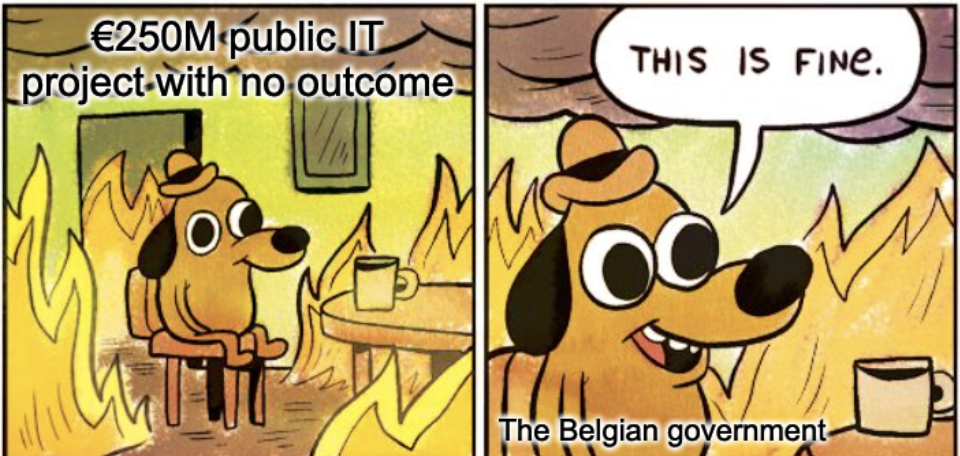
he Belgian government has stopped the failed i-Police digitalisation project after €76 million was spent with little result. The project was delivered by consultancy firm Sopra Steria, which remains under investigation. Despite this, the firm still holds six other government digitalisation contracts worth an estimated €250 million. The situation has triggered political criticism over oversight and reliance on external consultants.
What can we learn from this?
When projects reach tens or hundreds of millions, clients should never be uncertain about what’s actually happening, yet cases like i-Police show how easily large engagements drift without a clear, shared view of progress, decisions, and open issues. Work continues and invoices are paid, but outcomes stay abstract, not because the work is “good” or “bad,” but because clients lack real insight during the process itself. Status updates and steering committees create activity rather than clarity, and without concrete, visible proof of progress, issues remain invisible until they become public. Professional service firms protect trust and reputation by making progress unmistakably clear; when clients can’t see what’s going on, even solid work can end up looking like failure.

Team strategy offside
You know what they say: the best strategy is created in a floating meeting room. Nobody has probably said this before, but from experience: it checks out.

We took the team to Ostend to reflect on the past year, align on our strategy and roadmap, and talk openly about how to keep Alkmist a great place to work. All of it from a floating meeting room, surrounded by boats. Now: Back to building with sharper focus.

68% of clients had to re-explain themselves starting a new audit
(Insight from State of The audit 2025)
🔍 The Systems View
Toto De Brant, Co-founder Alkmist
From a technical standpoint, this result isn’t surprising. Client context lives in fragments today: emails, one-off requests, and follow-ups spread across tools and people. Most audit stacks are built around documents, not communication. But that’s where institutional memory actually begins. When communication isn’t structured, linked, and persistent, context disappears as soon as someone leaves the team. What the State of the Audit 2025 reveals isn’t a people problem. It’s an architecture problem. Clients don’t expect fewer questions, they expect their answers to be remembered.
💬 Behavioral Perspective
Mathias Celis, Co-founder Alkmist | Phd Psychology & Business Economics
Auditors aren’t wrong for asking the same questions. The problem is how those questions are asked. Clients aren’t frustrated by repetition. They’re frustrated by what it signals: “We didn’t look at last year.” The data shows that 68% of clients had to re-explain basic context, not because questions shouldn’t be asked, but because prior knowledge isn’t acknowledged. The difference is subtle. Not: “How is your organization structured?”But: “Last year, you had three departments. Have there been any material changes?”Same compliance. Very different signal. Trust is built by showing you remembered.

Implementing a new audit tool in 2026? Here are 5 tips for a smooth rollout
New audit tools can transform how your team works but only if the rollout is done right. As many firms plan technology changes in 2026, success won’t come from software alone, but from how well your team adopts it. Here are five practical tips to make sure your audit technology rollout delivers real value this year:
1. Appoint the right champions Involve users from every role, not just senior staff. Practical insights from day-to-day users speed up adoption.
2. Plan for hidden costs Training time and workflow changes matter. Intuitive tools reduce friction and learning curves.
3. Allocate real time and resources Don’t squeeze implementation between deadlines. Dedicated time prevents rushed, failed rollouts.
4. Set clear expectations Be explicit about what’s mandatory vs. optional. Clarity reduces resistance.
5. Choose contributors intentionally Pick motivated, capable team members, not just volunteers to keep the project on track.
See you for the next one!